Surviving Peak Traffic Surges: Queue-Based Load Leveling, Circuit Breakers, and Edge Rate Limiting

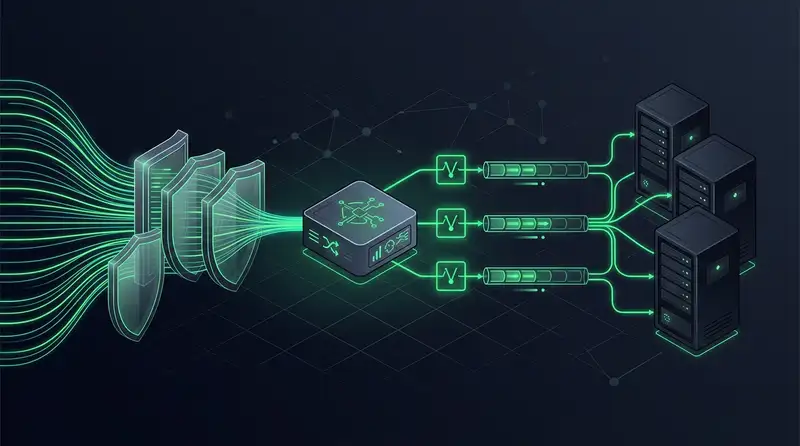
During major e-commerce events like Black Friday, flash sales, or product drops, web traffic rarely scales linearly—it arrives in violent, sudden 50x spikes within seconds.
Even well-cached Next.js storefronts or Magento clusters can collapse under sudden concurrency when uncached write operations—such as Add to Cart, Inventory Reservation, and Checkout Payment Processing—hammer the primary SQL database simultaneously.
When database connection pools saturate, requests pile up, timeouts cascade across microservices, and the entire storefront crashes with 502 Bad Gateway or 504 Gateway Timeout errors.
Here is the production blueprint for engineering traffic-resilient web architectures using Queue-Based Load Leveling, Circuit Breakers, and Edge Virtual Waiting Rooms.
1. Queue-Based Load Leveling for Write Operations
Read-heavy catalog pages are easily offloaded to Edge CDNs. However, write operations (order placement, webhook ingestion, inventory updates, and transactional emails) cannot be cached.
Instead of forcing your web server to execute synchronous database transactions and third-party ERP calls during a traffic spike, decouple ingestion from processing using an asynchronous Message Queue (Redis Streams, BullMQ, or RabbitMQ).
Architectural Flow:
[ 10,000 Concurrent Checkout Requests ]
                  │
                  ▼
    [ Fast Ingestion API (Next.js) ] ── (Returns 202 Accepted + Job ID in < 15ms)
                  │
                  ▼
     [ Redis / BullMQ Task Queue ]   ── (Buffers burst safely in memory)
                  │
                  ▼
    [ Controlled Worker Pool (Max 50) ] ── (Drains at steady DB-safe pace)
Implementing a Non-Blocking Order Queue in Next.js + BullMQ:
// lib/queues/orderQueue.ts
import { Queue } from 'bullmq';
import { redisConnection } from '@/lib/redis';

export const orderQueue = new Queue('checkout-orders', {
  connection: redisConnection,
  defaultJobOptions: {
    attempts: 4,
    backoff: {
      type: 'exponential',
      delay: 2000,
    },
    removeOnComplete: 500,
  },
});

// app/api/checkout/submit/route.ts
import { NextResponse } from 'next/server';
import { orderQueue } from '@/lib/queues/orderQueue';

export async function POST(request: Request) {
  const payload = await request.json();

  // Enqueue order immediately instead of blocking on SQL + ERP + Email
  const job = await orderQueue.add('process-order', {
    cartId: payload.cartId,
    userId: payload.userId,
    submittedAt: Date.now(),
  });

  // Respond instantly with 202 Accepted so frontend polls or listens via SSE
  return NextResponse.json(
    { status: 'queued', jobId: job.id },
    { status: 202 }
  );
}
By returning 202 Accepted in under 15ms, your frontend stays responsive while background workers drain the queue at a steady, predictable database concurrency limit.
2. Preventing Cascading Failures with Circuit Breakers
During peak surges, third-party dependencies—such as shipping calculators (FedEx/UPS), tax engines (Avalara), or ERP inventory APIs—often slow down or fail. If your checkout route waits 30 seconds for a failing external API, every Node.js or PHP-FPM worker thread locks up, taking down the entire site.
A Circuit Breaker monitors external API failures and trips open automatically when error thresholds are crossed:
- Closed State (Normal): Requests pass through to the external API normally.
- Open State (Tripped): After 5 consecutive failures or timeouts, the breaker trips open for 30 seconds. Incoming requests fail fast in
< 1msand return a graceful fallback (e.g., cached flat-rate shipping). - Half-Open State (Recovery Probe): After the cooldown window, 1 test request is permitted. If it succeeds, the circuit closes; if it fails, it stays open.
// lib/resilience/circuitBreaker.ts
type CircuitState = 'CLOSED' | 'OPEN' | 'HALF_OPEN';

export class CircuitBreaker {
  private state: CircuitState = 'CLOSED';
  private failureCount = 0;
  private nextAttempt = 0;

  constructor(
    private readonly failureThreshold = 5,
    private readonly cooldownMs = 30000
  ) {}

  async execute<T>(fn: () => Promise<T>, fallback: () => T): Promise<T> {
    if (this.state === 'OPEN') {
      if (Date.now() > this.nextAttempt) {
        this.state = 'HALF_OPEN';
      } else {
        // Fail fast without waiting on degraded upstream service
        return fallback();
      }
    }

    try {
      const result = await fn();
      this.onSuccess();
      return result;
    } catch (error) {
      this.onFailure();
      return fallback();
    }
  }

  private onSuccess() {
    this.failureCount = 0;
    this.state = 'CLOSED';
  }

  private onFailure() {
    this.failureCount++;
    if (this.failureCount >= this.failureThreshold) {
      this.state = 'OPEN';
      this.nextAttempt = Date.now() + this.cooldownMs;
    }
  }
}
3. Edge Rate Limiting & Virtual Waiting Rooms
When botnets and sneaker-style scalpers target flash sales, origin servers should never even see that excess traffic. Enforce sliding-window rate limiting and virtual queuing directly at the Edge Middleware layer:
- Token Bucket Rate Limiting: Throttle aggressive IPs hitting
/api/cart/addor/api/checkoutusing Upstash Redis or Cloudflare WAF rules. - Edge Virtual Waiting Room: When active concurrent sessions exceed your origin's safe capacity (e.g., 5,000 active checkouts), Edge Middleware issues a signed queue cookie and redirects excess visitors to a lightweight static waiting room page that auto-refreshes every 15 seconds.
Peak Resilience Strategy Comparison
| Protection Layer | Primary Bottleneck Solved | Latency Impact | Implementation Effort |
|---|---|---|---|
| Queue-Based Load Leveling | SQL Connection Pool Exhaustion | Sub-15ms ACK (Async UI) | Medium (Redis + Worker) |
| Circuit Breaker Pattern | Slow / Failing 3rd-Party APIs | < 1ms Fail-Fast Fallback | Low (Zero external deps) |
| Edge Rate Limiting / Waiting Room | Bot Surges & Flash-Sale Floods | 0ms Origin Load | Low (Edge Middleware) |
Pre-Peak Readiness Checklist
- Load Test with Realistic Write Ratios: Don't just benchmark cached
GETrequests. Use k6 or Artillery to simulate concurrentPOSTcart and checkout flows. - Audit Connection Pool Limits: Configure PgBouncer (PostgreSQL) or ProxySQL (MySQL) so serverless functions never exceed
max_connections. - Graceful Degradation Fallbacks: Ensure non-critical features (personalized AI recommendations, live reviews, loyalty widgets) degrade cleanly if latency spikes, keeping the core checkout path 100% available.
By combining asynchronous task queues, fail-fast circuit breakers, and Edge rate limiting, your e-commerce infrastructure stays rock-solid and profitable through the heaviest traffic surges of the year!
Need premium developer consulting?
Let's discuss how we can build API split checkouts, dynamic Next.js interfaces, or speed audits for your business.
Get in TouchRelated Technical Insights
Zero-Downtime E-Commerce Deployments: Blue-Green Deployments, Automated E2E Testing, and Database Migration Safeguards

Optimizing High-Throughput GraphQL APIs: Query Complexity Limits, DataLoader Batching, and Response Caching